



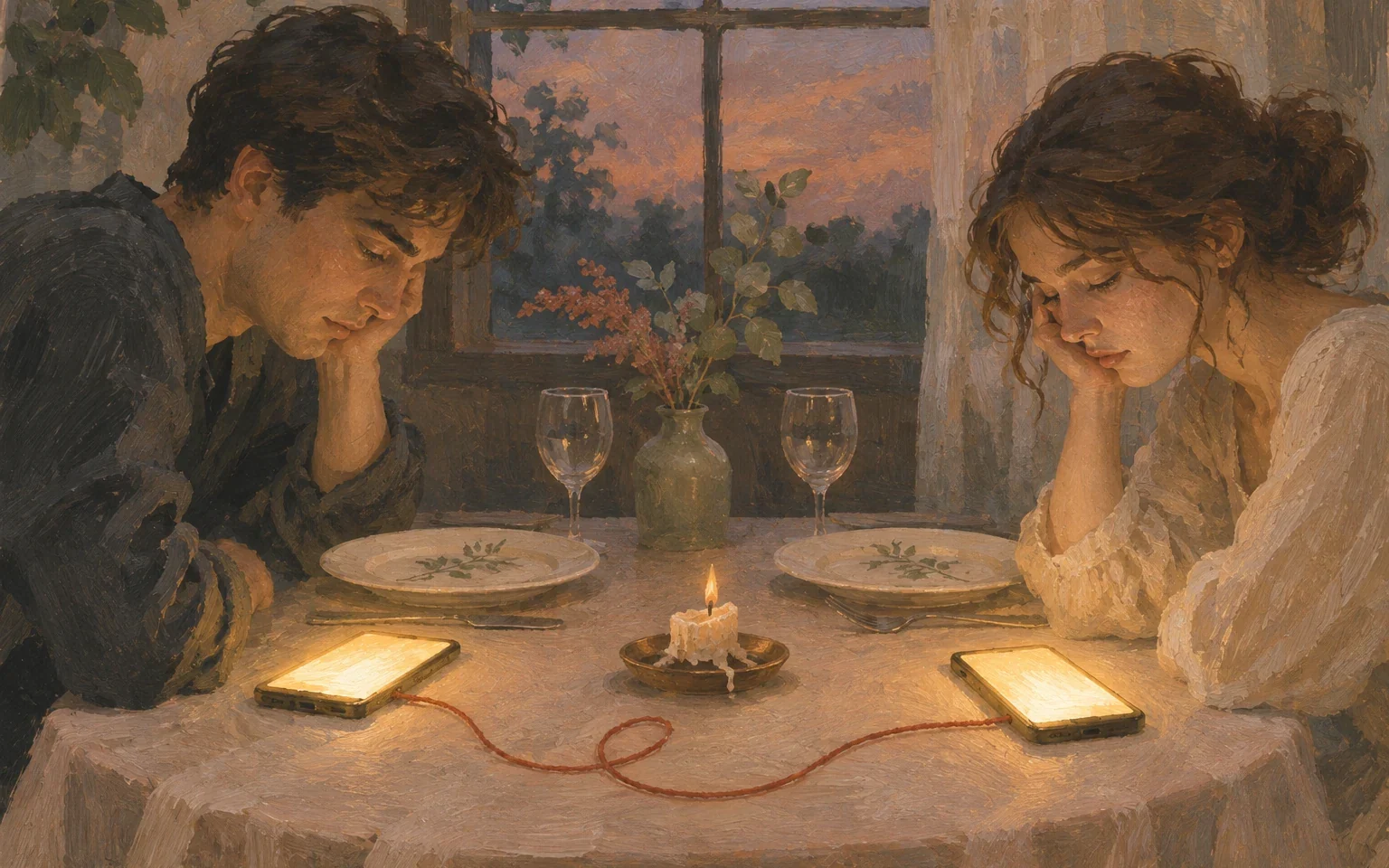
Dinner was pasta, nothing special, and it was good. The candle you lit half as a joke has burned down to a stub, the plates are pushed to one side, and both your phones lie on the table while your partner tells a story from work that is running slightly long.
It is an ordinary evening, and a happy one.
Then you glance at your phone. Someone you know is on a clifftop at sunset, celebrating an anniversary. They look radiant.
You look up. Same table, same person, still in the middle of the story. And the evening you were enjoying a minute ago suddenly looks small.
What you are really comparing
Nothing in the room changed. Only the measurement did.
A moment ago you were inside your evening. Now you are standing outside it, wondering how it would photograph.
Be exact about what you have just placed side by side. On one side is everything you know about your own life: the dull Tuesdays, the tired faces, the stories that run long. On the other is one minute of someone else's. It was chosen from many, lit well, captioned with care and offered to an audience.
That is not a fair comparison. It is edited evidence.
None of this means every happy post is a lie. Some people are as happy as they look. But a photograph cannot tell you whether two people can breathe around each other. A couple can seem adored on a screen and barely speak at dinner.
You are measuring a whole private life against someone else's best public minute.
You are measuring a whole private life against someone else's best public minute.
When love becomes a brand
Most of us have become small publicists for our own lives without ever deciding to. We choose the photograph. We rewrite the caption until it sounds effortless. New love even has its own ritual now, the soft launch: a hand at the edge of a picture, two coffee cups, a hint that something is happening.
There is nothing wrong with any of it. People have always shared their joy.
The trouble starts when the public story begins to stand in for the private one. When being posted starts to feel like being loved. When a moment does not feel finished until it has been seen. When the question at the table quietly changes from 'Is this good?' to 'Does this look good?'
Once that happens, an audience has entered the room. You are living the evening and producing it at the same time.
It also becomes harder to be honest. People stay a little longer because the good parts are already on show, and an ending would feel like failing in front of a crowd they cannot see.

Wanting to be seen is not shallow
This is not a rule against posting, or against wanting to be posted.
Wanting to be acknowledged in public is not shallow. Being included openly in someone's life can mean a great deal. And if a partner keeps you out of sight in a way that goes with avoidance, or with keeping their options open, that deserves a direct conversation.
But the wish can become tangled with something else, which is the need for proof. So ask yourself which of the two is speaking. Do you want to be included, or do you need an audience to confirm that you were chosen? If the care at home were steady and the public display modest, would you feel loved?
Some couples share almost nothing and are deeply committed. Others post every week and hardly talk. What helps is talking about it together, not to demand a display, but to learn what being acknowledged means to each of you.
The body you compare
The comparison does not stop at your relationship. It follows you to the mirror.
There was a time when impossible beauty belonged to film stars and magazine covers, and some part of you knew it was staged. Now it sits in the same stream as your friends' photographs and your own. Some of it is filtered, some reshaped, and some belongs to generated faces that have never had a pore, a bad night or an ordinary day.
Look at enough of it and your eye is quietly retrained. Your own face in the morning, and the tired face across the table, begin to look like things that need correcting.
If this has happened to you, it is not vanity. It is what daily exposure to an impossible mirror does to anyone.
A real body is not a failed image. It is the only kind that can hold a hand, laugh too loudly or fall asleep on the sofa beside someone.
You do not have to pretend that looks count for nothing. You only have to stop letting a manufactured standard decide who is allowed tenderness. That includes you.
Ordinary is not small
Underneath the comparing there is often a quieter fear. What if my life is ordinary? What if our story would not make anyone stop and look?
This is the perfect delusion at its most persuasive, the idea that an ordinary life is a failed one.
Yet most of what holds love up cannot be photographed. Someone who keeps their word. A text asking you to say when you are home safe. Reliability, repair and patience make poor content and a good life.
So letting an unremarkable evening be enough, without apology and without a photograph, is a small act of resistance. And keeping some of it to yourselves is not hiding. Privacy is not the same as secrecy. Secrecy conceals what a person ought to answer for. Privacy protects what is tender, so that it can be felt before it is shown.
Come back to the table, then, where the candle is nearly out and the story is still going. Ask the one question that returns the evening to its real size. 'Would this still matter if nobody saw it?'
If the answer is yes, you already have what the photograph was trying to prove.
Questions to sit with
- When did you last feel at ease with your evening, your body or your relationship, until you looked at someone else's?
- Which part of your life do you feel most pressure to prove online: your relationship, your singleness, your healing or your desirability?
- If the care you receive in private is steady and the public display is modest, what exactly feels missing?
- Which images have made you less kind to your own body?
- Which moments from the last month would still matter to you if no one else ever knew they had happened?
One small step
Try a small privacy ritual this week. Choose one kind of moment that will not become content. It might be dinners at home, first dates, gifts, a disagreement and the making up afterwards, or anything your partner tells you in confidence. Decide it now, and when that moment comes, leave the phone where it is.
Then, before you post anything about love, stop for one breath and ask, 'Am I sharing this, or am I trying to prove something?' If you are simply sharing, post it and enjoy it. If you feel a hunger for proof, or the other person has not agreed, wait a day. Nothing is lost by waiting. An unposted moment is still yours.

Filed underAI, Social Media & Love · Comparison · Social Media · Self-Worth
Keep reading
More from The Untangled Blog

Manipulation & Self-Trust
That Unsettling Feeling You Cannot Quite Name
The first sign may not be proof. It may be the feeling that something here is not right. How to listen to that feeling without panic, and without talking yourself out of it.
5 min read · May 1, 2026

Womanhood & Homecoming
When the Life That Looks Right Does Not Feel Like Home
You did what you were supposed to do, and people tell you how well it turned out. If part of you still feels far from home, that is not ingratitude, and it does not mean your life has to be torn down.
6 min read · November 18, 2026
Womanhood & Homecoming
The Scripts You Never Chose
The fairy tale, the girlboss, the perfect body, the good daughter. Each script promised you something real. The question is not which one is correct, but whether you ever chose the one you are living by.
6 min read · November 18, 2026

Get new essays in your inbox
A short note when a new essay is published. Nothing in between.