




You know why you left. You could give the reasons in order, calmly, to anyone who asked.
It is three weeks later, a quiet Sunday evening. The flat is tidy and nothing is wrong.
And your body wants them back. Not as an idea you could weigh up, but as a force in your chest that will not be argued with.
You have opened a new message and typed their name.
What frightens you is not only the wanting. It is what the wanting seems to prove: that it was love after all, or that you are a fool.
It proves neither.
What a trauma bond is made of
Start with what is true. The pull is real, and you are not being dramatic.
It is also not evidence. Its strength comes from the way the bond was made, not from the quality of what you had.
A trauma bond is an attachment that forms when hurt and comfort keep arriving from the same person, in turns. Coldness, then warmth. Fear, then tenderness. Distance, then return. It happens often enough that your body stops keeping the two apart, and learns one rule instead: the way out of this pain is through this person.
They fell silent, and only they could end the silence. They said the thing that made you feel worthless, and only a rare kind word from them seemed able to mend it. You went to the source of the hurt for the comfort, because for a long time that was the only place comfort was kept.
You were not foolish. You were bonded, and the bonding was done by repetition, not by any weakness in you.
From the inside, withdrawal can feel exactly like love.
When withdrawal feels exactly like love
So when you leave, you do not only lose a person. You lose the one thing your body knew to reach for when it hurt.
And leaving hurts. So the ache sends you straight to the place it was trained to go. Your thoughts circle. Your chest is tight. You are certain that one message would make it all stop, and for an evening it would.
From the inside, withdrawal can feel exactly like love. It has the same urgency, and the same single name in it. 'If it hurts this much to be without them,' the feeling argues, 'then it must have been love.'
There is an older confusion underneath this one. For a long time, the best moments with them were the moments when the pain lifted. The silence ended. The cold look softened. Ordinary kindness came back, and it felt like a gift. The absence of pain was taken for the presence of love.
So the ache settles nothing. A bond made this way hurts when it is cut, however you were treated inside it.
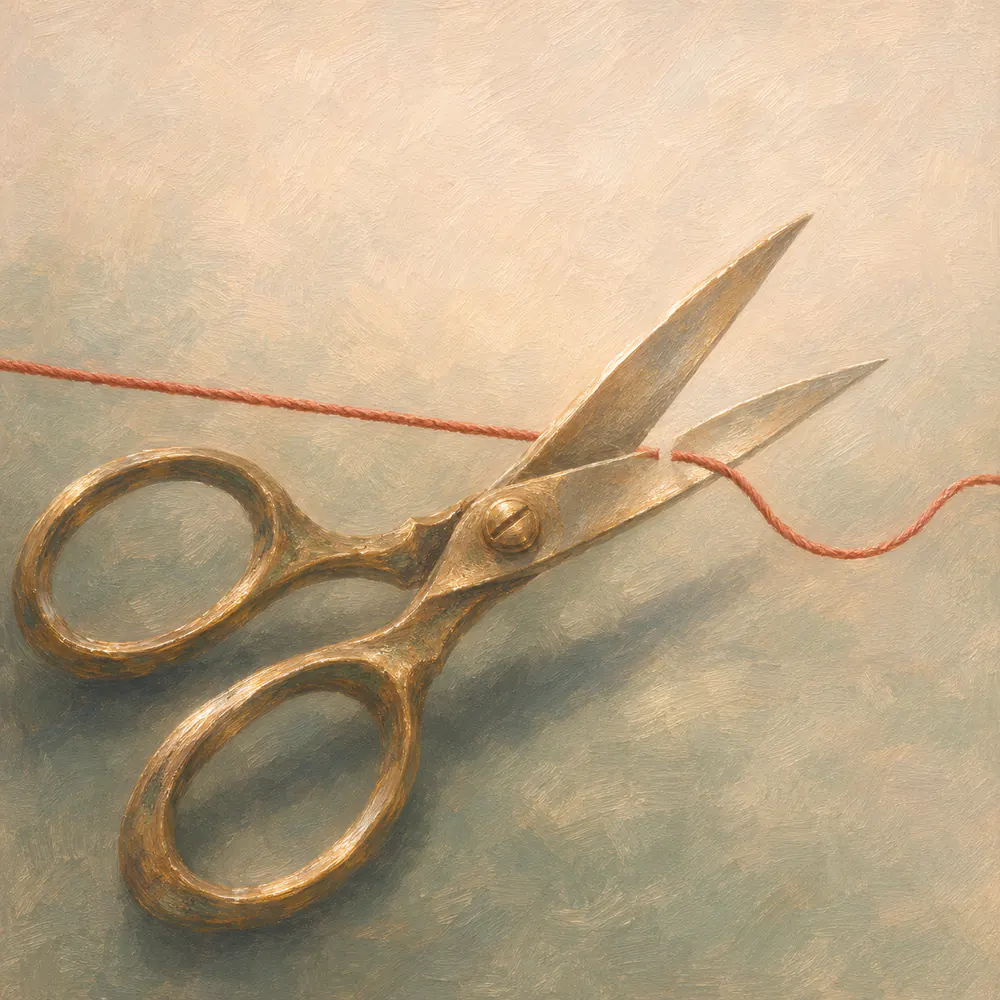
Two stories that cannot both be true
Your mind has had its own work to do.
All through the relationship you were holding two stories about one person. In the first, this is the one who brought you soup when you were ill and told you that nobody had ever understood them as you did. In the second, this is the one who said something cruel and then looked through you while you cried.
Both things happened. But the two stories will not sit side by side, so the mind settles the matter as gently as it can. It keeps the warm story as the true one and explains the other away. They were under pressure. They did not mean it.
Or it turns the explanation on you. 'If I had been more patient. If I had asked for less.' Blaming yourself hurts, and it also offers a strange comfort. If it was your fault, then it was something you could fix.
None of that was weakness. It was a mind trying to make sense of what did not make sense.
The habit outlasts the leaving. On a quiet Sunday evening, the warm story is the only one speaking.
What memory keeps and what it loses
Memory is not a fair record-keeper here.
It keeps the highlights. The best night. The way they looked at you when they were soft. Those moments were vivid, partly because they came straight after the worst stretches.
The cost was never a single scene. It was spread thinly across ordinary days. The careful wording of every sentence. The friends who heard from you less and less. The way a whole day took its colour from one person's mood.
None of that makes a memory. So three weeks on, your mind offers you a relationship made only of its best evenings and asks, 'Was it really that bad?'
You do not have to argue with the good memories. They happened, and some of what was said may even have been meant. The honest question is what the whole of it was like to live in. Your body kept that account all along, even when hope preferred not to read it.
Let the wave be a wave
So here you are, with their name typed and the message still empty.
You do not have to win the argument with your body. A wave can be recognised without being obeyed. You can say, quietly, 'This is the bond. It is not a decision.'
If you have sent that message before, or gone back once, or several times, there is no shame in it. It shows how strong this kind of bond is, and it undoes nothing you have understood since.
One thing does change the picture. If what holds you is not only longing but fear, if there were threats, if they watched where you went or kept hold of the money, if you are frightened of what they might do now that you have gone, then this is not something to settle alone with a phone in your hand. Talk to qualified support where you live and to one or two people you trust, and make a quiet, practical plan together. You do not owe anyone a last conversation, or an announcement that you will not be in touch. Staying quietly out of reach is sometimes the wiser way.
The wave rises, insists and passes. Healing does not mean that it stops coming. It means that you find your way back to yourself a little sooner each time.
Questions to sit with
- When the pull comes, what does it promise you will feel if you give in to it?
- During the relationship, who caused your worst distress, and who did you turn to for comfort?
- Which warm memory does your mind return to most, and what had been happening in the days before it?
- If a friend described this same pull to you, what would you say to them?
One small step
Make a short reality list before the next wave. Do it on a calm day, not in the middle of one.
Write five plain facts, in your own words: what happened, what was said, and how your body felt most of the time. 'I apologised most weeks for things I had not done.' 'My stomach hurt on the way home.' Leave out their reasons and your theories.
Store the list where the other person cannot reach it. When your memory starts bargaining, read it through once before you do anything else.

Filed underTrauma Bond Recovery · Trauma Bonds · Leaving · Missing Someone
Keep reading
More from The Untangled Blog

Manipulation & Self-Trust
That Unsettling Feeling You Cannot Quite Name
The first sign may not be proof. It may be the feeling that something here is not right. How to listen to that feeling without panic, and without talking yourself out of it.
5 min read · May 1, 2026

Womanhood & Homecoming
When the Life That Looks Right Does Not Feel Like Home
You did what you were supposed to do, and people tell you how well it turned out. If part of you still feels far from home, that is not ingratitude, and it does not mean your life has to be torn down.
6 min read · November 18, 2026

Womanhood & Homecoming
The Scripts You Never Chose
The fairy tale, the girlboss, the perfect body, the good daughter. Each script promised you something real. The question is not which one is correct, but whether you ever chose the one you are living by.
6 min read · November 18, 2026

Get new essays in your inbox
A short note when a new essay is published. Nothing in between.