



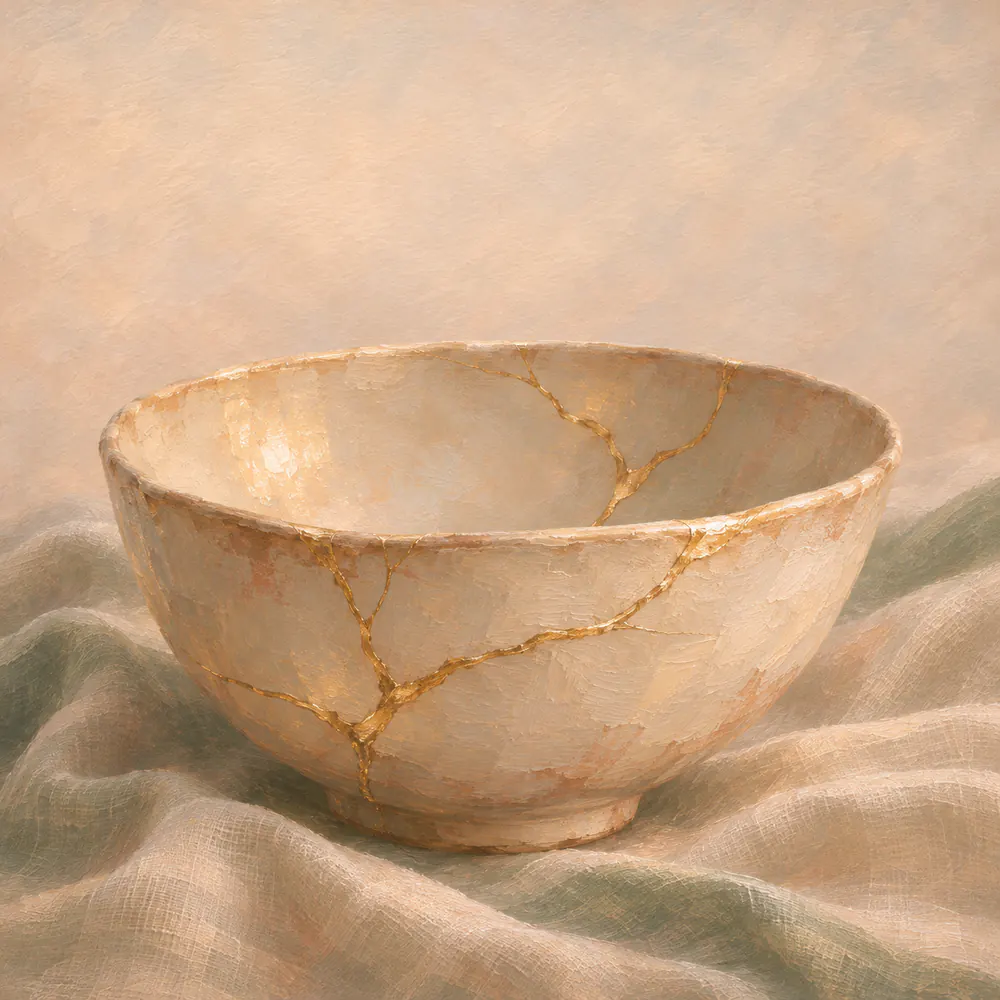
Someone asks where you would like to eat. You say, 'I do not mind,' the way you have said it a thousand times, and the talk moves on.
Then you notice that it is true.
You are not being easy-going, and you are not keeping the peace. You looked for an answer, and there was nothing there.
At some point you stopped knowing what you like, and you could not say when.
How a person gets smaller
It did not happen in a day. It happened by small corrections, over a long time.
You gave an opinion, and it was silly. You had a feeling, and it was an overreaction. You asked for something, and you were needy. You were hurt, and you were too sensitive.
So you adjusted. Agreeing was easier than defending your taste in films. Cooking what they liked was easier than the mood that followed anything else. Their favourite place became your favourite place. You learned their tastes and their tempers so thoroughly that you lost the thread of your own.
Being told again and again that you are too much teaches you to become less. You say less. You need less. You want less, until you are not sure what you want at all.
You were not too much, you were with someone who needed you smaller.
What you asked for was ordinary. Clarity, honesty, reassurance and respect are not excessive, however often they were made to sound that way.
You were not too much, you were with someone who needed you smaller.
The voice that stayed behind
The person has gone. The commentary has not.
'That was a stupid thing to say.' 'I brought it on myself.' 'Nobody will want me after this.'
It speaks in the first person, in your own voice, so you take it for your own opinion. Listen to the words, though. You have heard them before, and not from yourself.
You do not need to win a fight with this voice. Three small moves are enough.
Notice it. 'There is that old voice again.'
Ask it a gentle question. 'Is that entirely true? Whose voice does it sound like? What would I say to a friend I love, if they said this about themselves?'
Then answer with something fairer. Not a cheer, because you will not believe a cheer. Something you can stand behind. 'I am healing from a great deal of pain, and I have worth even on the days I cannot feel it.'
That is all self-compassion means here. It is not self-pity, and it is not an excuse. It is a decision to speak to yourself as you would to a friend who turned up at your door with this same story.

Reintroducing yourself to yourself
Now back to the question at the table. What do you like?
Begin very small, and expect some blankness. What do you eat when nobody else is choosing? What music do you put on? Which clothes feel good on your body, and which were you only told to wear?
You may not know. Not knowing is not failing. Asking is the work.
Then spend your days simply noticing. You try a new coffee and do not care for it. That is an opinion. A song comes on and you turn it up. That is another. Someone walks past in a bright yellow coat and something in you lifts.
Each one steadies your compass a little.
Look back, too. What did you love before them? Walking, painting, dancing in the kitchen? Bring one thing back, with no need to be good at it. Or try something new and do it badly. Make the lumpy bowl at the pottery class, and laugh.
One caution, which matters more than the rest. All of this needs room. If the person who needed you smaller is still close enough to punish a preference, if there are threats or violence, if your phone, your money or your movements are watched, or you are afraid of what would happen if you left, then keeping your opinions to yourself is not low self-worth. It is how you are staying safe. Do not try out a new voice on someone who punished the old one, and do not announce what you are planning. Find qualified support where you live, tell someone you trust, make a quiet, practical plan with them, and keep anything you write where the other person cannot reach it. Your preferences will wait for you.
Confidence is a result
Confidence is not something you can decide to feel. It is what builds up when you do what you told yourself you would do.
For a long time, nothing you did changed anything. You pleaded, you reasoned, you were kind, you were angry, and the hurt came anyway. A person who lives like that learns to stop trying.
The way back is through goals almost too small to fail. A ten-minute walk. One reply to a friend. One simple meal. The bed made.
The task is not the point. The proof is. Each one is a coin in a jar. One coin is nothing, but you add another tomorrow, and in time the jar has weight.
Do not skip the last step, which is to stop and say it. 'I said I would, and I did.'
Take back, too, the strengths that were renamed as faults. Your kindness was called naivety. Your staying power was called stubbornness. Your thoughtfulness was called overthinking. They were strengths then, and they are strengths now.
More than what happened to you
There comes a point where understanding what was done to you stops being enough. You need a life again.
It does not have to be a perfect one. Friends, food, sleep, music, small choices and some private peace will do.
'Survivor' is a true word for you. You came through something that takes people apart. But it is one true word, and there are others.
Be a little careful that healing does not turn into another performance, something to get right while people watch. You do not have to recover impressively. Ordinary peace, practised daily, is enough.
You were not destroyed. You were trained to distrust yourself, and what was trained can be retrained, in steps as small as choosing your own lunch.
You are more than what happened to you.
The next time someone asks where you would like to eat, you may need a moment. Take it. Then name a place.
Questions to sit with
- When did you last say 'I do not mind' and realise you had no answer to give?
- Which words were used to tell you that you were too much, and which of them do you now use on yourself?
- What did you love doing before this relationship, and where did it go?
- Which of your strengths were described to you as faults?
- If 'survivor' is one true word for you, what are three more?
One small step
Think of self-trust as a ladder, and stand on its lowest rung. Each day this week, choose one small preference and honour it. The food you want for lunch. The music in the kitchen. The route you walk home. The film you watch tonight.
Keep it small enough that nothing depends on it. You are not practising being right. You are practising having an answer.
And if someone asks what you would like, say it aloud. 'The Italian place.' 'The seat by the window.'

Filed underTrauma Bond Recovery · Self-Worth · Inner Critic · Identity
Keep reading
More from The Untangled Blog

Manipulation & Self-Trust
That Unsettling Feeling You Cannot Quite Name
The first sign may not be proof. It may be the feeling that something here is not right. How to listen to that feeling without panic, and without talking yourself out of it.
5 min read · May 1, 2026

Womanhood & Homecoming
When the Life That Looks Right Does Not Feel Like Home
You did what you were supposed to do, and people tell you how well it turned out. If part of you still feels far from home, that is not ingratitude, and it does not mean your life has to be torn down.
6 min read · November 18, 2026
Womanhood & Homecoming
The Scripts You Never Chose
The fairy tale, the girlboss, the perfect body, the good daughter. Each script promised you something real. The question is not which one is correct, but whether you ever chose the one you are living by.
6 min read · November 18, 2026

Get new essays in your inbox
A short note when a new essay is published. Nothing in between.