



You have just said it, as kindly as you could. You cannot do what they asked this weekend, you are sorry, and the weekend after might work.
There is a pause on the line. Then a sigh, long enough for you to hear all of it.
'Fine. I will manage on my own, as usual.'
Nothing has been demanded. And yet your free hand is already reaching for the diary, to see what could be cancelled.
The sentence beneath the sentence
On the surface, someone in your family has said they will manage. It is a plain statement, almost a brave one.
Underneath it runs a second sentence, and that is the one you heard. 'A good person would not leave me to do this by myself.'
That second sentence is the hook. A hook is the lever that pulls you away from what you know is right for you, and guilt is one of the most reliable. It goes for the tender part of you that wants to be loving, loyal, fair and grateful.
The request has quietly become a test of what kind of person you are, and a no now seems to prove that you are selfish, cold or ungrateful.
A fair request leaves room for either answer. A guilt hook leaves only one answer that lets you go on feeling like a good person.
The hook only works on people who care about being decent, which is why it keeps finding you.
The hook only works on people who care about being decent, which is why it keeps finding you.
Guilt you earned and guilt you were handed
Guilt is not the enemy. Sometimes it is exactly right.
You forgot the call you promised to make. You spoke sharply. You broke an agreement. That guilt is uncomfortable and useful. It points at something specific you did, and it shows you how to mend it.
The other kind is vague, and it sticks. It points at nothing you did, only at what you are. Selfish. Ungrateful. Not the person you used to be.
Real responsibility says, 'I did this, and I need to put it right.'
Manufactured guilt says, 'They are unhappy, so it must be mine to fix.'
The first ends in repair. The second ends with a little less of you each time.
So ask whether you can say, in one sentence, what you did wrong. If you can, own it and make it right. If all you can find is that someone is disappointed, you are holding the other kind.
Be fair to the person on the phone, too. They may truly be tired, they may truly need help, and they are allowed to be disappointed. One heavy sigh on a hard day is not a pattern. What matters is whether guilt has become the usual reply to your no.

Why it catches the kind ones
Before the sigh has ended, you have pictured the whole lonely weekend at the other end of the line.
That is empathy, and you should keep it. The trouble starts when it only runs one way. You feel their disappointment and step over your own tiredness. You feel their loneliness, and the no you meant never gets said.
The hook dresses differently in different places. In a family it comes wrapped in history. 'After all we gave up for you.' In a relationship it sounds like a debt. 'I told you everything, and now you want an evening to yourself?' At work it borrows the language of the team. 'The rest of us are staying late.'
There is something true near each of these. Families do make sacrifices, partners do affect each other, and work does have heavy weeks. But being grateful does not mean signing your life over, and being considerate is not the same as doing as you are told.
If resentment has begun to grow, it does not make you unkind. It is what moves into the space where a no should have gone.
Answering without turning cruel
This kind of guilt has a feel. A weight on the chest. A hot face. A throat that closes, and a rush to fix things at once. You may feel about nine years old, waiting to hear that you are good.
Before you answer, ask one thing. 'Am I saying yes because I care, or because I am afraid of looking like a bad person?'
Care is steady, even when it costs you a Saturday. Fear is in a hurry. If you cannot tell which is speaking, wait a day before you answer.
And when the answer is no, keep it short and keep it warm. 'I care about you, and my answer is still no.' Say it once, and resist the urge to defend it.
It will feel unfinished, and they may be hurt. But being disappointed is not the same as being wronged. Often it is the ordinary feeling of a grown person who hoped for a yes and did not get one, and you can let them feel it.
Sometimes what sits under the guilt is fear. If a no brings threats, if your money, your phone or your movements are watched or controlled, if you are frightened of what will follow, do not start with a clean sentence, and do not confront anyone. Start with quiet support from qualified people where you live and from people you trust, and plan carefully. Keep what you are learning to yourself for now, if saying it aloud would be punished. Naming a hook is a beginning. It is no substitute for having people beside you.
When the guilt has moved inside you
After enough years, nobody needs to sigh at all. You hear it before you have opened your mouth. You picture the disappointment, you predict the cold voice, and you say yes before anyone has had to ask twice.
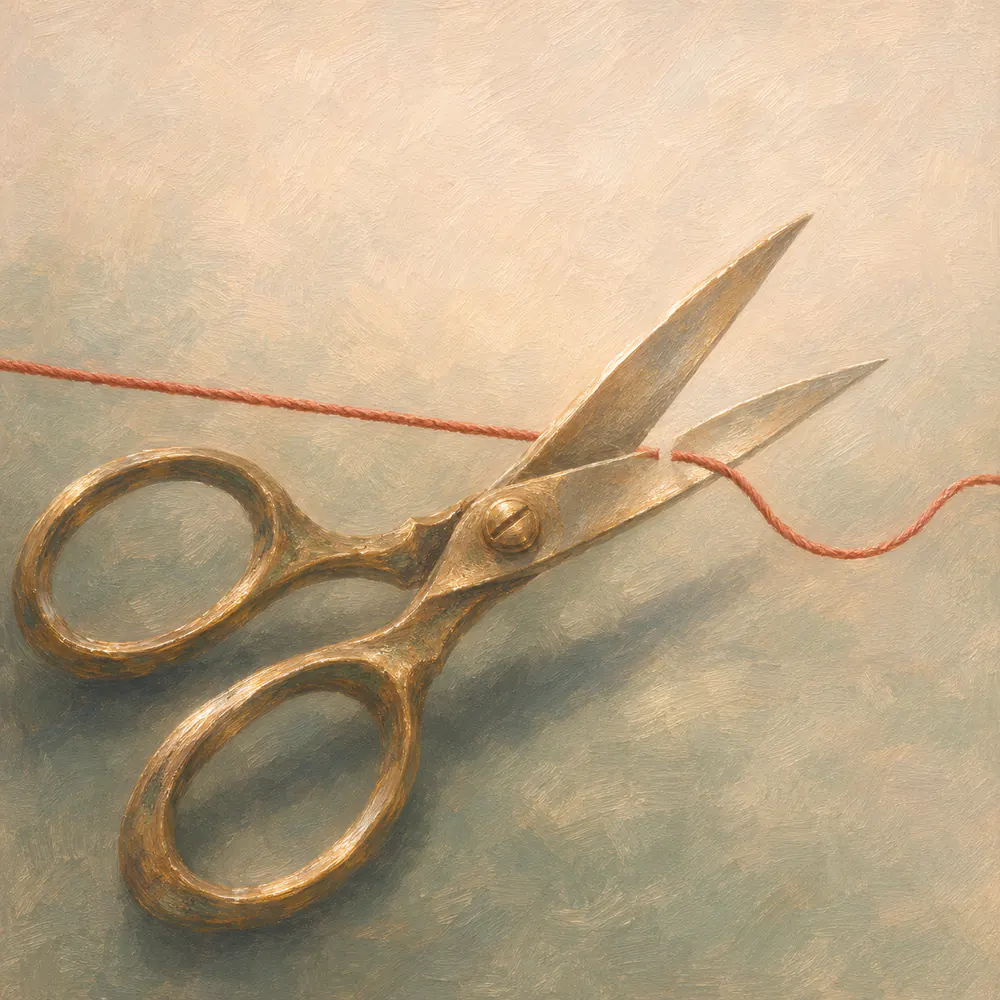
The hook has moved inside, and now you are the one who pulls it.
So when guilt rises in an empty room, ask whose voice it is. Ask who taught you that saying no makes you bad.
Do not judge yourself for the answer. A great deal of a kind person's life can end up arranged around not feeling guilty, and noticing that is where the unhooking begins.
None of this asks you to care less. It asks you to notice who is deciding, you or the guilt.
Questions to sit with
- Which sentence, from which person, makes you start explaining yourself at once?
- When someone close to you is disappointed, how quickly do you decide it is yours to fix?
- Where do you say yes mainly to remain the good one, the loyal one, the helpful one?
- Which no have you been putting off because of what someone might think of you?
One small step
The next time guilt rises this week, do not answer straight away. Ask one question first, aloud or on paper. 'What exactly am I responsible for here?' Then answer it specifically. What you said, what you did, what you promised, and any repair you owe are yours. Another adult's every mood, their reading of you and their difficulty in hearing a no are not.
Then ask a second question. 'If I were not trying to prove that I am good, what would I choose?' Take the first answer that comes, even if it surprises you.
If the first question turns up something you really did, mend that. Then give your answer from what is left.

Filed underManipulation & Self-Trust · Guilt · Boundaries · Empathy
Keep reading
More from The Untangled Blog

Manipulation & Self-Trust
That Unsettling Feeling You Cannot Quite Name
The first sign may not be proof. It may be the feeling that something here is not right. How to listen to that feeling without panic, and without talking yourself out of it.
5 min read · May 1, 2026

Womanhood & Homecoming
When the Life That Looks Right Does Not Feel Like Home
You did what you were supposed to do, and people tell you how well it turned out. If part of you still feels far from home, that is not ingratitude, and it does not mean your life has to be torn down.
6 min read · November 18, 2026

Womanhood & Homecoming
The Scripts You Never Chose
The fairy tale, the girlboss, the perfect body, the good daughter. Each script promised you something real. The question is not which one is correct, but whether you ever chose the one you are living by.
6 min read · November 18, 2026

Get new essays in your inbox
A short note when a new essay is published. Nothing in between.