




You can tell what kind of evening it will be from the sound of their key in the door. A quick, light turn means one thing. A slow one, and then a pause before the handle, means another.
By the time they reach the kitchen you have chosen your voice, your face, and what not to mention tonight.
You have always been good at this.
You were good at it long before you met them.
An echo begins somewhere else
Somewhere in a relationship with a person you can never quite reach, or long after it, a question arrives quietly. Why me? Why did someone who could not love me steadily pull at me so hard? Why did I keep trying?
A tired mind answers that question cruelly. Maybe I draw this to me. Maybe the fault is in me.
Go slowly here. Two questions are folded together, and they are not the same. One asks, 'What in me made this pull so strong?' The other says, 'So it was my fault.' The first brings clarity. The second brings only shame.
We are choosing the first.
And the answer usually starts earlier than this person. Call it the echo, an older ache that the relationship woke up.
An echo is a sound that began somewhere else. That is why it can feel so much larger than the moment that seems to be causing it.
The pull you felt was a kind of recognition, and you can only recognise what you have met before.
What you were already good at
Look at the skills you carried in with you.
Maybe you have a rescuer's heart. You see the hurt behind a hard manner, and you move towards it. So when they said, 'I have never told anyone this,' something in you stood to attention. You would be the one who finally understood them well enough.
Maybe you carry the peacemaker's burden. You were the easy one, the good one, the one who smoothed things over. You learned to keep your own needs small and to say sorry first, because an apology cost less than an argument.
Maybe there was an empty space, a quiet belief that you were never quite enough. Their early attention filled it so completely that the old critical voice fell silent. And when the coldness came, you did not think, 'They have changed.' You thought, 'I knew it.'
None of these is a defect. Empathy, steadiness, loyalty and hope are among the best things in you. They became a way in only because nothing was standing guard over them.
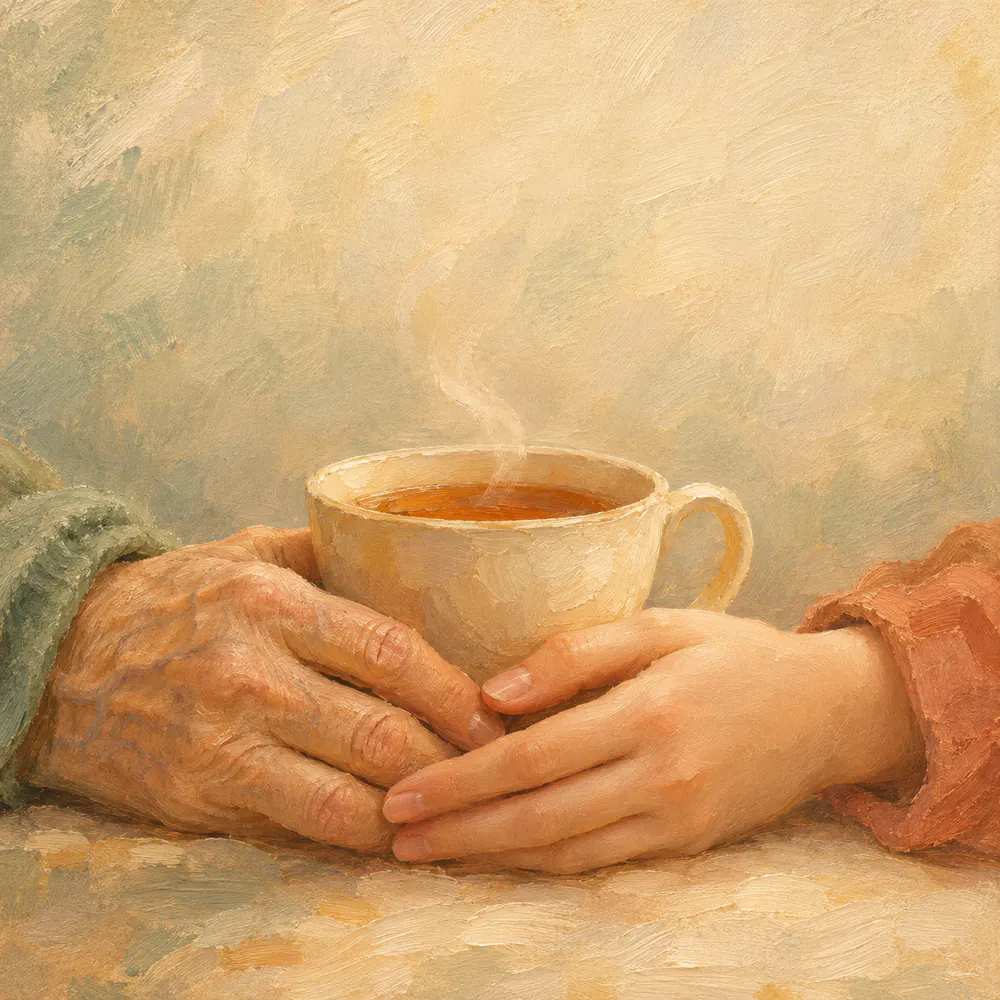
Why familiar can feel like fate
The pull you felt was a kind of recognition, and you can only recognise what you have met before.
If approval was hard to win when you were young, a critical person does not feel like a warning. They feel like work you already know how to do, and their rare praise feels like a prize you have been chasing all your life.
If warmth came and went, you learned to watch for it. You learned to read footsteps, silences, a key in a lock. Someone whose attention comes and goes then feels less like a stranger and more like a language you already speak.
Meanwhile a person who is simply there, steady and available, may leave you strangely unmoved, or feel a little too close. You were taught how to work for warmth. Nobody taught you what to do when it simply stays.
Familiar is not the same as safe. Familiar only means you already know your part.
This is not about finding someone to blame, in your childhood or in yourself. It is about hearing where the sound began.
The quest that was never yours to finish
Often, the person you were trying so hard to reach was standing in for an earlier one. Underneath the effort to earn their love ran an older effort, to earn the love of whoever first held it back.
That is why stopping felt impossible. Walking away from them felt like giving up on the oldest hope you had. It felt like admitting that the first wound would never be mended.
If you stayed for years, or left and went back, this is part of why. You were not blind. You were trying to finish something that mattered to you long before they arrived.
The hope was real. So is the wound, and so is the wish to have it healed.
But the quest was aimed at someone who could not complete it. They could not give you what the earlier person did not give, however well you loved them and however little you asked for. It was never a measure of your worth.
You can understand someone completely and still not stay. Stepping back is not abandoning the quest. It is taking it back into your own hands.
How you step back matters, though. Reading a key in a door is one thing. Being afraid of the person who comes through it is another. If what you are listening for is danger and not a mood, if there are threats or violence, if your phone is checked, your movements are followed or the money is kept from you, or if the thought of leaving frightens you because of what they might do, then none of this is for saying aloud at home. Do not confront them with what you have understood, and do not announce that you are going if leaving quietly would be safer. Take it instead to qualified support where you live and to someone who has earned your trust, and build a practical plan with them. Keep anything you write where it cannot be found. You have spent a long time keeping someone else calm. Let this careful, quiet planning be something you do for yourself.
Being needed, being loved
There is one more knot to loosen.
Being needed and being loved can look alike from the inside. Both keep you close to someone. But one keeps you working, and the other lets you rest.
If you were mostly needed, for your patience, your calm, your endless understanding, of course it felt like love. It may have been the only kind you were ever shown.
Hearing the echo will not make the pull disappear. But the next time someone out of reach feels like fate, you will know where the sound is coming from.
The care you kept carrying to them has somewhere else to go now. It can turn towards the place that ached first.
Questions to sit with
- In this relationship, did you feel you had to earn love, and how did you try?
- When did being needed feel so much like being loved that you could not tell them apart?
- Whose moods did you learn to read first, long before this person?
- What would it mean to stop asking this person to mend something that began before them?
One small step
Take ten quiet minutes this week, with a pen and one sheet of paper. Ask yourself one question: which old ache did this person seem to promise to heal?
Write the answer in a single line. Do not explain it. Underneath, write whose love you were first trying to earn.
Nothing needs to be done with the page. You do not have to show it to anyone, forgive anyone or decide anything. You are only letting yourself see where the echo started.

Filed underTrauma Bond Recovery · Emotional Unavailability · Old Wounds · Self-Worth
Keep reading
More from The Untangled Blog

Manipulation & Self-Trust
That Unsettling Feeling You Cannot Quite Name
The first sign may not be proof. It may be the feeling that something here is not right. How to listen to that feeling without panic, and without talking yourself out of it.
5 min read · May 1, 2026

Womanhood & Homecoming
When the Life That Looks Right Does Not Feel Like Home
You did what you were supposed to do, and people tell you how well it turned out. If part of you still feels far from home, that is not ingratitude, and it does not mean your life has to be torn down.
6 min read · November 18, 2026

Womanhood & Homecoming
The Scripts You Never Chose
The fairy tale, the girlboss, the perfect body, the good daughter. Each script promised you something real. The question is not which one is correct, but whether you ever chose the one you are living by.
6 min read · November 18, 2026

Get new essays in your inbox
A short note when a new essay is published. Nothing in between.