



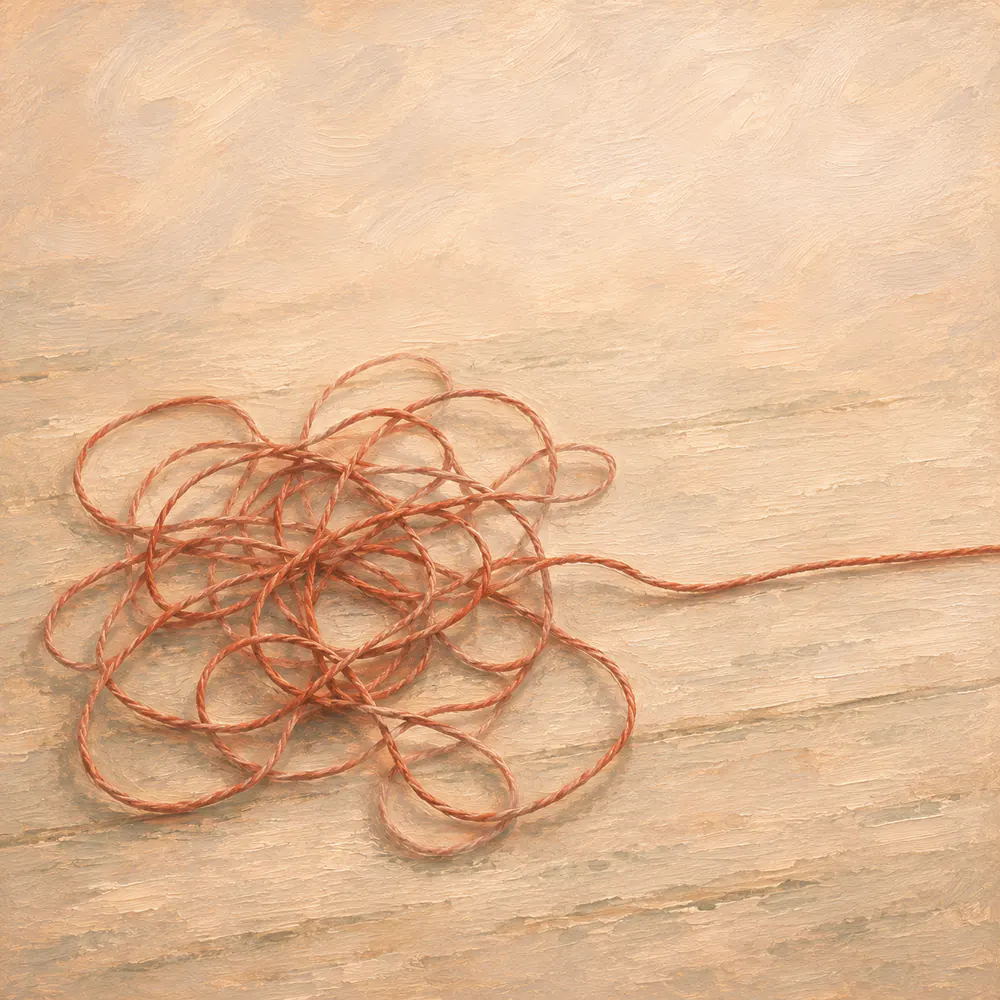
The visit is over, and nothing went wrong. Nobody raised their voice, nobody said a single thing you could repeat to a friend, and at the door there were thanks and a wave.
Now you are at the sink with the cups. The water is warm, the house is quiet, and your shoulders are still up near your ears.
So you start the list. They were only tired. You slept badly. You read too much into things, you always have. It was a perfectly nice afternoon.
By the third cup you have almost talked yourself round. Your shoulders have not moved.
The body notices first
Your body often registers a change well before you have a sentence for it.
It picks up the compliment that works like a small test. The apology with no responsibility in it. The affection that seems to come with strings.
And it notices you. The way your voice turns careful around one particular person. The way you grow more agreeable, quicker to smile, more useful, as if some part of you had worked out that honesty is not quite welcome here.
The mind prefers a clean story, with someone good, someone bad and a clear answer about who was right. The body is less tidy. It offers something smaller and harder to argue with, which is that something here deserves attention.
The alarm does not always ring. Sometimes all you can say is that the ease has gone. Someone asks a favour and you feel cornered. Praise lands and you feel assessed.
None of these is a verdict. Each is a signal, and a signal deserves curiosity.
You do not need perfect proof to slow down and pay attention.
Why kind people overrule themselves
You may have been praised all your life for being understanding, mature, no trouble, the one who copes. Somewhere along the way, being good came to mean being easy to be around.
Those are lovely qualities. Left unprotected, they are also an open door.
Manipulation rarely comes in through your faults. It comes in through your goodness. Your empathy finds a reason for what keeps hurting. Your loyalty keeps you in places where you are shrinking. Your fear of being unfair stops you from naming what is unfair.
So the list at the sink is not foolishness. It is your goodness, working overtime for somebody else.
And some of the list may be true. People bring old hurts with them. Everybody says things badly sometimes.
But understanding why someone behaves as they do is not an agreement to keep absorbing it. They may be having a hard time, and your shoulders are still up near your ears.

A moment and a pattern
Taken one at a time, these things look far too small to mention.
Say one aloud and hear how it sounds. 'They went a bit quiet after I said no.' 'They forgot what they had promised.' Anyone would tell you that people go quiet and people forget, and anyone would be right.
That is why one afternoon cannot settle it. A single moment can be misread, by you as easily as by anyone else. One clumsy remark from a tired person is a clumsy remark.
One incident is a moment. A pattern is a message.
So the question worth asking is not whether today was bad enough. It is whether today has company. Does the same confusion keep coming back? Do you come away, again and again, a little less sure of yourself than you arrived?
A pattern can show what a sentence conceals. A person may tell you they respect you, and the pattern may show that the respect appears only when you agree.
Seeing that is not a diagnosis, and it is not permission to hate anyone. It is only what has been happening, seen together for once.
When the proof has not arrived
On the day your body first notices, you may have no proof at all. Where there is manipulation, it lives in tone, in timing, in what is implied, and in the distance between what is said and what is done.
So for now you may convince nobody, yourself included.
You do not have to. Winning the argument is not the job at this stage. The job is to stop overruling yourself while you wait to see more.
You do not need perfect proof to slow down and pay attention.
Slowing down is modest. You take a little longer before you agree to the next thing. You say to one friend you trust, 'I am not sure what this is yet.' You ask yourself whether you feel freer around this person, or managed.
One short test helps. Anxiety wants control, and it wants it now. Intuition is quieter and steadier, and all it wants is your attention.
If you distrust every sensation you are easy to confuse, and if you obey every one at once you are easy to provoke. An alarm is a reason to look around, not a reason to burn the building down. You look for smoke, you find the exits, and you notice who is standing in the doorway.
If what you find when you look is fear, that changes the next step. Threats, being watched, someone deciding where you may go or what you may spend: none of that is answered by a confrontation, or by telling the person what you have begun to see. Go quietly to people trained to help, close to where you live, and to someone you trust, and plan with them before you do anything else. Reading may give you words for it. Keeping you safe takes people.
Naming it without making it bigger
There is a sentence small enough to say at the sink.
'Something in me tightened there.'
Not 'They are a bad person.' Not 'I am losing my mind.' Not 'That settles it.' Only what happened in you, said plainly.
The sentence lets your body speak, so the feeling is not buried under the list of reasons. And it asks your mind for nothing yet, so the feeling does not harden into a judgement you would then have to defend.
Overthinking goes round and round. Observation notes one true thing and stops.
A compass that has been talked over for years does not vanish. It goes quiet, and it answers when it is asked.
You can finish the washing up. Nothing has to be decided tonight. You only have to stop telling your shoulders that they are wrong.
Questions to sit with
- Who are you with when your body tightens before your mind knows why?
- Which of your body's signals do you find easiest to overrule?
- What do you fear would happen if you slowed down instead of smoothing things over?
- Is there something you have been calling a run of misunderstandings?
One small step
This week, practise naming without escalating. The next time your body reacts around someone, say one thing to yourself, silently, and nothing more. 'Something in me tightened there.'
That evening, answer two plain questions. Have I felt this around this person before? Did I feel free to respond honestly? A yes or a no is enough for each.
Then stop. No verdict yet, and nothing you need to announce to anyone. You are not deciding what kind of person they are. You are only declining, for one evening, to talk yourself out of what you noticed.

Filed underManipulation & Self-Trust · Intuition · Self-Trust · Patterns
Keep reading
More from The Untangled Blog

Manipulation & Self-Trust
That Unsettling Feeling You Cannot Quite Name
The first sign may not be proof. It may be the feeling that something here is not right. How to listen to that feeling without panic, and without talking yourself out of it.
5 min read · May 1, 2026

Womanhood & Homecoming
When the Life That Looks Right Does Not Feel Like Home
You did what you were supposed to do, and people tell you how well it turned out. If part of you still feels far from home, that is not ingratitude, and it does not mean your life has to be torn down.
6 min read · November 18, 2026
Womanhood & Homecoming
The Scripts You Never Chose
The fairy tale, the girlboss, the perfect body, the good daughter. Each script promised you something real. The question is not which one is correct, but whether you ever chose the one you are living by.
6 min read · November 18, 2026

Get new essays in your inbox
A short note when a new essay is published. Nothing in between.